
Every Branch a Labor: Reading Plath’s Fig Tree through the Working-Class Dreams
On wanting everything in a world that lets you choose so little

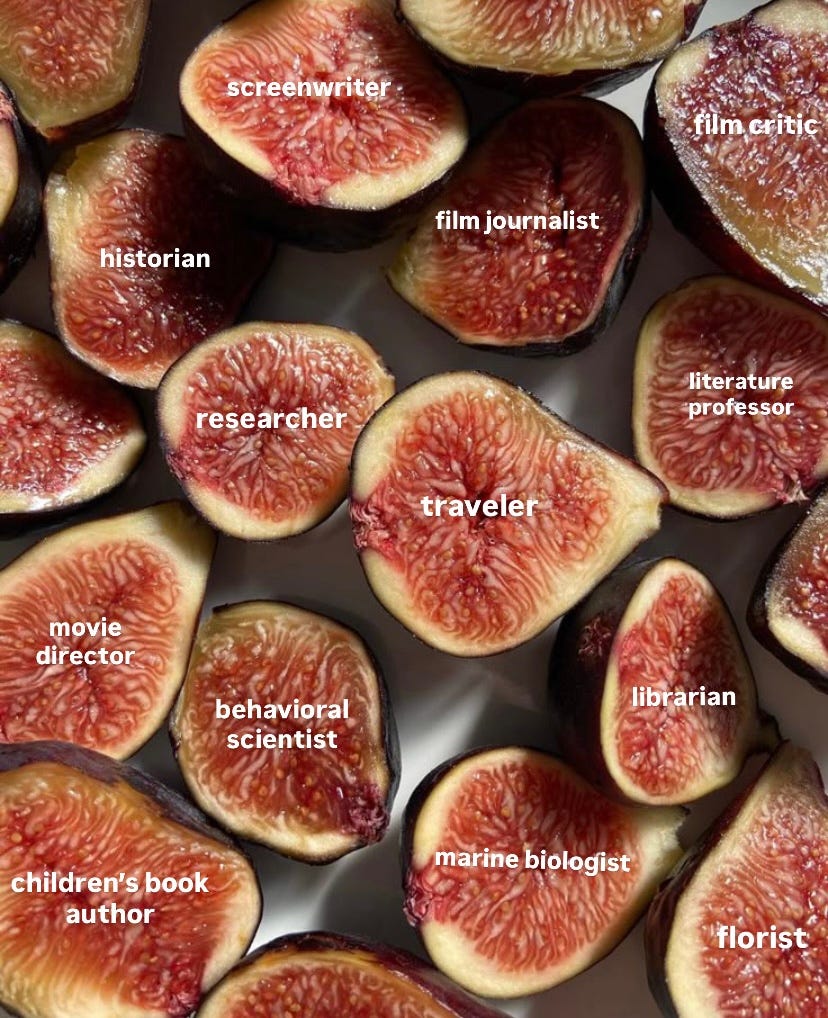
When I first read Sylvia Plath’s fig tree, I didn’t think of lovers or children or art. I thought of jobs. Each branch looked like a different form of employment: a writer, a teacher, a social media strategist, and a person who never stops producing. Maybe that’s what happens when you grow up working-class; even your dreams come with punch clocks. When Esther Greenwood, Plath’s stand-in in The Bell Jar, looks at her life branching before her like “the green fig tree in the story,” each fig representing a possible self, I recognized that tree immediately. Except in my version each fruit has a salary range, a LinkedIn profile, and a probation period.
Plath’s original passage is one of the most haunting images of modern literature where Esther sees her life splintering into possibilities: wife, mother, poet, professor, traveler, and lover. But the abundance of choice becomes unbearable. She wants everything but choosing one means losing the rest. So she sits there watching her figs wither and fall to the ground. It’s a moment of pure existential claustrophobia disguised as plenty: the tragedy of the twentieth-century self who is told she can be anything but discovers she cannot be everything.
When I revisit this scene, I think about how that paralysis mutates in a working-class context. For Esther, indecision is a symptom of anxiety and alienation. For me and many people I know, indecision often feels like a luxury we can’t afford. The working-class fig tree doesn’t rot from hesitation; it’s pruned by necessity. You pick the fruit within reach because the rent is due, not because it’s the sweetest. And yet the longing to taste every fig remains. It’s not just about ambition but about an aching multiplicity — the desire to experience life fully, in all its contradictions, while knowing that survival often demands narrowness.
Plath wrote The Bell Jar in 1963, at a time when women were expected to choose between domesticity and ambition, Her fig tree is gendered and each fruit symbolizing a socially sanctioned role. But beneath that, it’s also deeply economic. The paralysis she describes—the inability to decide one’s path—is intensified by her awareness of what each choice costs. The poem “The Applicant” shows this same tension, turning marriage into a transaction and a job interview for domestic labor. Plath understood, even if she never named it in Marxist terms, that capitalism infiltrates desire and that it teaches us to measure ourselves by productivity and outcomes.
When I think of my own fig tree, the figs aren’t lovers or distant countries. My fig trees are occupations. Each one a different way to be useful, to be seen, and to be paid. I want to be a writer (yes!) but also a researcher, a community worker, a traveler who gets paid for her travelling contents, and maybe even a florist who starts working work at 7 in the morning and leaves at 5pm. I want to be everything and every version of that everything is filtered through labor. That’s the inheritance of class consciousness: to imagine the self as a worker first and a dreamer second.
But Plath’s metaphor isn’t just about ambition. It’s about hunger and unbearable appetite for life’s fullness. The figs glisten with potential. That hunger resonates with me, too, though mine often feels more desperate; less about yearning for infinite possibility and more about fearing the collapse of the few possibilities I have. The working-class imagination is rarely allowed to wander too far as we are told to be practical and realistic. But even pragmatism has a cost and sometimes it means learning to silence the parts of yourself that want more and to pretend you don’t even see the figs higher up the tree. In this way, Plath’s fig tree becomes not only a symbol of choice but a diagram of social inequality. Who gets to sit under the tree and contemplate which fig to pick? Who’s told the fruit isn’t meant for them? Plath’s paralysis stems from excess but mine and many others’ often stems from scarcity. Yet both lead to the same place: a kind of spiritual fatigue and the exhaustion of wanting in a world that rewards efficiency over wonder.
On the other hand, I can’t dismiss the fig tree entirely as tragedy. Sometimes I catch myself daydreaming about other lives I might have lived. A fig for the version of me who writes poetry full-time. Another fig for the one who never leaves her hometown. Another for the one who studies psychology and joins a grassroots mental health collective, or another fig for the one who quits everything to garden. Each is real and grows in the same soil of want.
If Plath’s metaphor captures the paralysis of choice, maybe our generation captures the paralysis of exhaustion: the endless balancing of dreams against deadlines. The figs are still there but the light has changed. Sometimes I still think of the tree often, of Esther sitting beneath it, and of myself beside her counting hours instead of figs. I want to tell her that wanting everything isn’t a curse. It’s a pulse and a proof that we’re still alive.
Maybe in the end, the lesson isn’t about choosing the right fig or even choosing at all but to keep the tree alive. The working-class fig tree might not feed every dream but it still grows.
To remember that I am more than my paycheck even when my paycheck decides who I can be.
Incredibly well written and reflective, my Fay ❤️ When witnessing the fig tree and all of its possibilities borne in the form of fruits, there’s always a trailing thought of “What kind of experience should I acquire to increase my credibility so that I can pluck this fruit from the tree?” And suddenly it is no longer a basic food for human’s needs or a source of life, but an ultimate reward & you wrote it all so eloquently I love this so much!!!!